


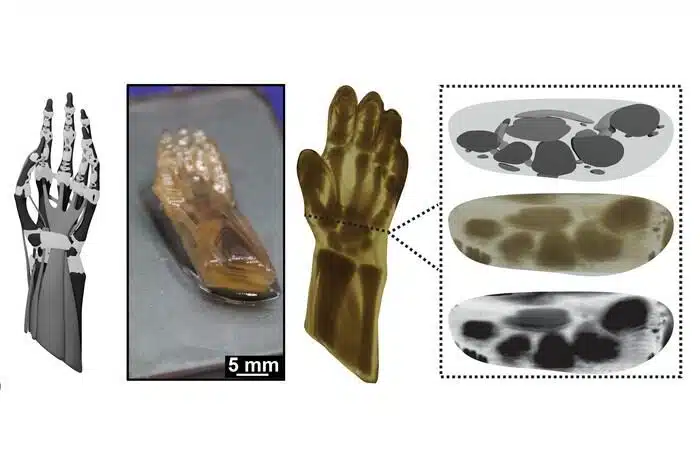
The future of medical training and bioengineering just took a massive leap forward in accessibility. Researchers from the University of Texas at Austin, along with Sandia National Laboratories, have unveiled a 3D-printed human hand so realistic it flawlessly mimics soft tissue, flexible ligaments, and rigid bone.
The breakthrough? No complex multi-material hardware was needed. Instead, the team used a single, affordable resin processed through a novel technique called CRAFT.
CRAFT: Transforming Light into Biological Texture
Traditional high-fidelity 3D printing often requires switching between different materials, which is slow and expensive. The CRAFT technique (Crystallinity Regulation in Additive Fabrication of Thermoplastics) solves this by using light to “program” the material.
By adjusting light intensity during the printing process, the molecular structure of a cyclooctene-based resin changes as it solidifies. This allows a single object to have rigid, bone-like areas right next to soft, skin-like sections. The result is a seamless, functional model that feels and moves like human anatomy.
High-End Med-Tech for Under $1,000
The most exciting part for the 3D printing community and universities is the low barrier to entry. This method doesn’t require industrial machines; it works with standard, budget-friendly LCD or DLP resin printers.
With a setup costing less than $1,000, even underfunded research centers can now produce high-quality anatomical models for surgical practice. Beyond medicine, this technique could lead to better protective gear, lightweight armor, and advanced soundproofing materials.